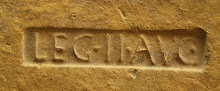
Here is a close up of the material for my new legionary scarf. It was supplied by Cezary Wyszynski of Legio XXI Rapax in Poland. It is hand spun and hand woven.
I dyed it madder red on the weekend workshop, having pre mordanted it with Alum.
And here is what inspired it, an original fragment from the Roman military quarry site of Mons Claudianus dating to the Second century AD. It was excavated under my old professor, Valerie Maxfield.
This site is dedicated to a very particular hobby... reconstructing Roman Legionary equipment for the Second Augustan Legion's advance into the ancient British Westcountry.
It involves a great deal of travel, study, handwork and occaisonal fun!!
Wednesday, 18 November 2009
Monday, 16 November 2009
The Thorsbjerg Tunic - Mark 1!
This is our first attempt at the sleeved tunic found at Thorsbjerg, Denmark. It likely dates to the 4th/5th century AD.
All stitching techniques follow the original.
This reconstruction was made with hand woven natural wool purchased in Afghanistan. The selvedges were kept intact. Mark two tunic will be handwoven tabby and diamond twill, dyed red with madder and will have tablet woven decorative borders, but probably wont appear on this blog for another few months yet!!!
All stitching techniques follow the original.
This reconstruction was made with hand woven natural wool purchased in Afghanistan. The selvedges were kept intact. Mark two tunic will be handwoven tabby and diamond twill, dyed red with madder and will have tablet woven decorative borders, but probably wont appear on this blog for another few months yet!!!
Dyers Workshop
Five of us met up last weekend for our second dyers workshop, at the Button Family farm in Carmarthenshire.
Steph's fleeces are alledged to be the 18th best sheep fleece in the UK, so the location was perfect!
After being introduced to the wool making team, who spent much of the weekend chewing in the adjacent fields, we set to work. The naalbinden cap was a kind present from Miriam Bloema of Archeon.
We spent day one on trial pieces with Madder, Marigold, Oak and Weld as dyestuffs, and Alum, Copper, Iron and Tin. Despite the lack of experience, we achieved a pleasing range of fast colours.
Day two was serious work getting our legionary scarves dyed a nice shade of madder red. I used my diamond twill hand woven wool for this. The results were rather pleasing!!
Next workshop will focus on waterproofing our garments with felting and greasing, I expect we will learn a great deal more.
Steph's fleeces are alledged to be the 18th best sheep fleece in the UK, so the location was perfect!
After being introduced to the wool making team, who spent much of the weekend chewing in the adjacent fields, we set to work. The naalbinden cap was a kind present from Miriam Bloema of Archeon.
We spent day one on trial pieces with Madder, Marigold, Oak and Weld as dyestuffs, and Alum, Copper, Iron and Tin. Despite the lack of experience, we achieved a pleasing range of fast colours.
Next workshop will focus on waterproofing our garments with felting and greasing, I expect we will learn a great deal more.
Clothing Research
Its time to get serious about clothing!
First comes a great stack of books, which I always establish before making anything new... here is the dining room table full of books I'm going to need if I'm going to improve my kit authentically.
My aim is to get a full set of clothing done over the winter, in time for the spring, and I'm going to need it too...
Currently we're planning marching up mountains to the highest part of the German Limes, bivouacing in the Brecon Beacons, and tracking boar in the New Forest.... all in period clothing. Its going to need to be more than just looking okay, but work as practical outdoor clothing.
Monday, 2 November 2009
Enemy seen...
Here is a fantastic image from Folkert, our indigenous Late Pre Roman Iron Age person. (or 'celt' for the less politically/archaeologically correct!!)
This impression represents the early La Tene period, which is earlier than our normal era, but was such a good photo I had to include it!
Image taken by Janine Janusch and Jim Mulliner
This impression represents the early La Tene period, which is earlier than our normal era, but was such a good photo I had to include it!
Image taken by Janine Janusch and Jim Mulliner
Sunday, 1 November 2009
The campaign season closes
With the final event of the season, at the Peat Moors Centre in Somerset, the 2009 campaign season is over. It's now time to march back to the drill square and workshops, under the watchful eye of the centurion!
Thursday, 29 October 2009
Water bottles
The ultimate fighting machine runs on water, and dehydration sky rockets when soldiers are forced to fight or labour in body armour. That the Roman soldier carried water, or that water would need to be carried for him, is beyond question.
Unfortunately evidence for the personal carriage of water is not obvious in our era. Contemporary military sculpture does not give any clear hints.
Some re-enactors choose to use metal containers as these are robust and have been found on Roman sites in Northern Europe. However, we have been unable to provenance such items before the third century AD, and may have been used for oil, not water.
Ceramic water bottles are possible, and although less likely to withstand rough handling can be padded with basketwork or matting, which is evidenced by surviving finds on civilian sites. In our minds however, the key disadvantage to ceramic water bottles is the heavy weight when full. Gourds are possible, and although gourd seeds have been found at the Saalburg Roman fort in Germany, evidence is pretty thin.
Given its light weight, leather seems to be a good alternative. Several fragments of leather water skins have been found at Roman period sites in Egypt, some of which have early military associations. Interestingly, many of these leather fragments are made from simple intact goatskins, and similar types are still in use in the developing world today. This raises the question as to whether the hide shaped bag on Trajan’s column was intended by the sculptor to represent a water skin. This is at variance with Fuentes’ interpretation that water was carried within a container in the net bag. The reconstruction of just such a water skin, based on fragments from Egypt and Israel, is likely to be a future project for us.
Subscribe to:
Posts (Atom)